Saturday, January 4, 2014

Tips to start your next (or first) Skyrim game off right


A lot of my friends are only just now getting around to starting their first game of Elder Scrolls V: Skyrim, and many have asked for tips at how to make their first steps as useful as possible. As a "veteran" of the game with three characters totaling an embarrassing 500 or so hours, I was happy to put my otherwise useless knowledge to work and have decided to put my best tips here for anyone to have access to.

Here are my recommendations on the best way to start off your new character in ESV Skyrim:

Pay for a tour of Skyrim
From the first city you encounter, most likely Whiterun, spend the extra cash and take a wagon ride to
Screenshot from the Elder Scrolls wiki, found here.
every other city in Skyrim.  Once you've been to a location, you can fast travel back whenever you want, as long as you're not over-encumbered or surrounded by bad guys.  By traveling to every city this way, you now have a free pass to fast travel to any of them at your leisure instead of wandering the map, half lost and low on health.

You'll find the carriage for each city somewhere near the city's entrance. Talk to the carriage driver, who should be sitting in the front of the carriage, to access the list of locales to visit.  For the most part, this functions much like the stilt striders and guild transport in ESIII Morrowind where each city has a different fee, depending on how far it is from you.

Join the Thieves Guild for the fence
Tonilia, fancy seeing you here ... again.
Though the quests don't exactly push you in this direction, try to go to Riften as soon as possible to start the Thieves Guild quests.  Not only is Restore the Thieves Guild one of the most time-consuming quests of the game, but also once you become a member of the Thieves Guild, you have access to a fence, someone who buys and sells stolen goods and carries sellable lock picks in their inventory.  It takes doing a few favors for the guild before you can officially use your first fence, but it is so very worth it.

With the first character I played, I had no idea where to find a fence but was already over-encumbered with stolen flatware, clothes, armor and weapons before I'd finished the main storyline quests around Whiterun (about five to 10 hours into the game).  If you only follow the quests, you'll have nowhere to sell your unwanted stolen items until you, one day, incidentally end up in Riften.

As an added bonus, the fence here gets additional money made available in her bank each time you complete a stage in the Restore Thieves Guild quest line.  Take advantage of it.

Take advantage of the Riften glitch
The Black-Briar Meadery in Riften is home to an NPC with short-term memory loss.  He works
behind the bar and loves to talk.  At one point in the conversation, you have the option to use a speech check on him.  If it is successful, XP is added to your character's speech.  Talk to him again, and he'll talk about the same thing, offering you the same opportunity to up your speech.  Talk to him again, and he'll do it all over again.

This is great for characters who are just starting out or characters like my current Nord melee who is leveled up enough that getting XP this way might make the difference between leveling up in one play session or seven.

Is it repetitious? Yes. Is it worth it?  Also yes.
If you don't mind being a hooligan
Another way to level up in Riften, the most useful of Skyrim's cities, is by heading up to the balcony at the top of the Riften castle, Mistveil Keep, and raining death upon the simple townsfolk.  If you're a low enough level, you won't kill the townsperson, but you will get either sneak or archery XP, depending on how you play it.

By hiding on the balcony, popping up and shooting a townsperson, then either ducking again or running back into the castle and ducking out of sight, your character can level up without having a battle to fight.  Besides, it's kind of fun.  Just be sure you don't aim at someone you may need for a quest later.  They won't like it, and somehow, they'll know it was you shooting at them, even if you don't get caught.

For reference, banks replenish after two days
As a little additional information, NPC banks are replenished after 48 hours.  If you have too much to sell and don't want to run between traders, just wait twice for 24 hours each time, and the trader you just wiped out should have his or her money back, ready to trade again.

Know something about the Greybeards
Melee-ers will have to wait for the dragon to land before giving it what for.
For your consideration, meeting up with the Greybeards does allow you to start using dragon shouts, but it will also open you up to random encounters with dragons. This may be okay for ranged fighters, but magica and melee fighters will find dragons a little harder in the beginning and might want to put off the random encounters until they've leveled up a bit.

As a predominantly melee fighter myself, I say go for it. Dragon fighting leads to XP and much more exciting play. Besides, many of the initial dragon attacks tend to occur in towns. Guards will help fight off a dragon if one spawns in their area, and they have bows. Just make sure the dragon doesn't kill an NPC attached to a quest or you've lost the quest.

Make stuff and make stuff better constantly
Smithing and enchantment are important parts of Skyrim, even if they're not characteristics you usually give much attention. Start smithing and enchanting early and frequently.  Eventually, the armor your merchants sell will cap off, but with high smithing and enchantment, you can make far better armor than anything you could find for sale. Paying attention to these categories early ensures that you'll be prepared for when your merchants' armaments suddenly begin sucking.

Spare a few perks for those categories as well.  As you gain perks in smithing, you'll be able to work with better materials.  As you gain perks in enchantment, you'll be able to create more powerful enchantments and, eventually, bond multiple enchantments to a weapon or armor, creating something monstrous.

That's all the starter tips I have for now.  Good luck in Skyrim!

Friday, November 15, 2013

In honor of the new Bioshock Infinite DLC


Bioshock is one of the few game series that has drawn me in from the beginning, stomped on my happiness, and then pulled me back in. I can't wait to play the noire-themed DLC that came out this past Tuesday, but my love for the series prompted me to require my boyfriend to play through all three games before I was willing to download my season pass. I wanted a recap, and he needed to understand the world before I played the newest installment in front of him non-stop.
 
Before I run off to download my Buried at Sea DLC, I thought it only fitting that I also post a quick critical recap of all three games. Though the oldest came out years ago, and the newest is already a year old, this is just one of those series that, like Halo or Final Fantasy, every gamer should at least try to be familiar with because it's really that good.
 
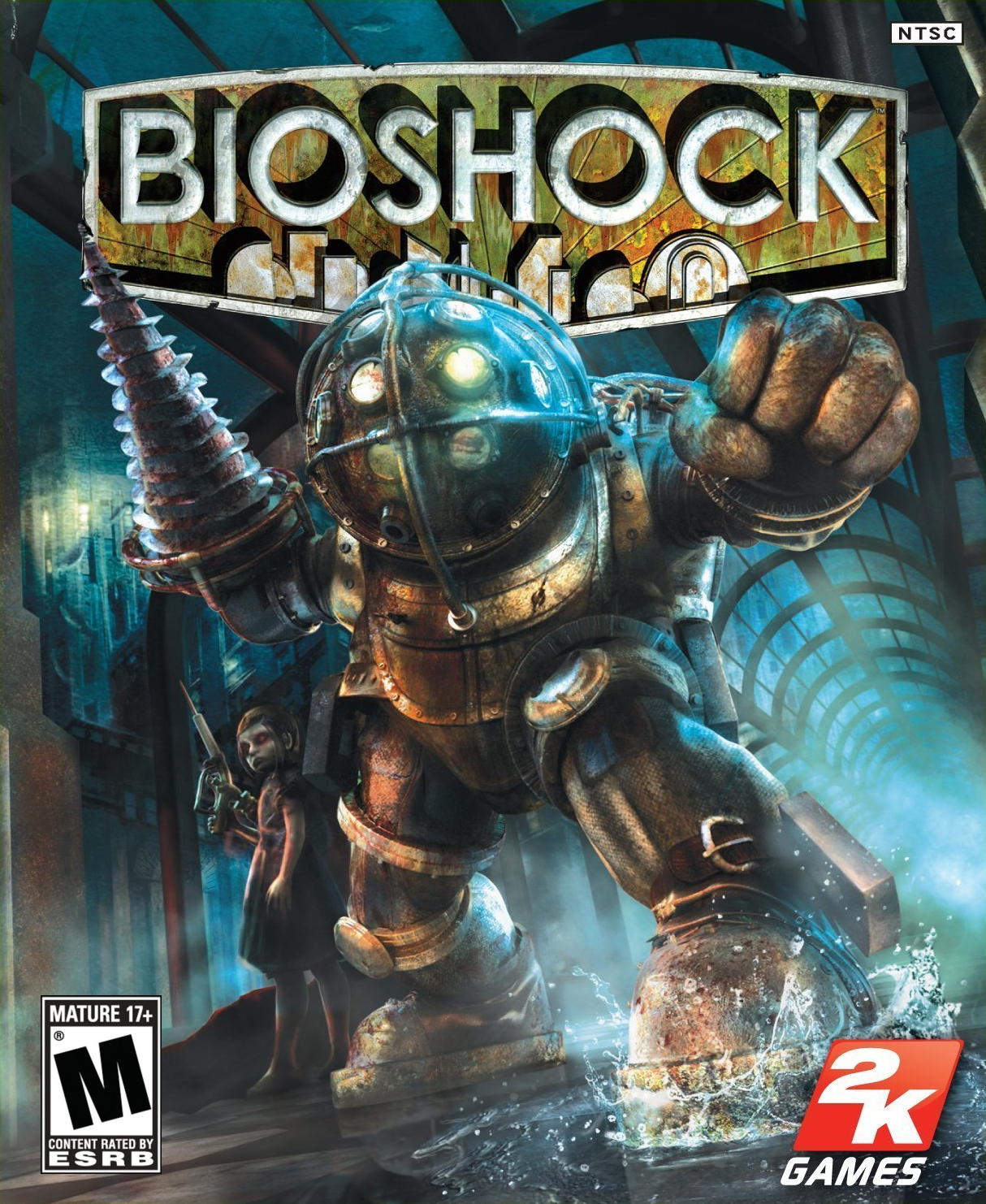
The first Bioshock, set in the underwater city of Rapture, boasted a new version of zombie (beyond-help ADAM addicts called Splicers), a gamer-friendly predictable level and goal structure through their use of the Big Daddies and Little Sisters, and a fantastic story to tie it all together. On top of that, the game's manipulation of the player's parental-instincts, through the cries of the Little Sisters, seemed to make it nearly impossible to put down.
 
Much of the story in the original Bioshock centers around Andrew Ryan's capitalist, no-holds-barred society that was once a haven for scientists and artists who worked in a moral gray area. Now their city has been destroyed, and the player is led to believe that a rebellion has sprung up, rejecting Rapture's soulless treatment of humans and leading you, Jack, on a quest to put what can be changed right again. Of course, that's all bunk, and we realize that about 3/4th of the way through the game in an exciting reveal that has become one of Irrational's signature moves. The design of Rapture was unique, the game's world was unique, and I was very impressed the product the designers at Irrational Games for getting it so right on their first attempt at a first-person-shooter.

Then came the concept game.

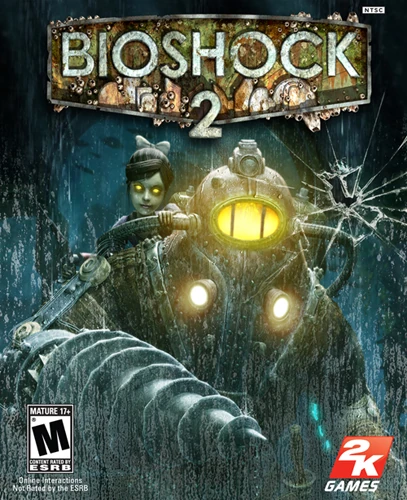
In the second game, the player gets to play as a Big Daddy, which is really exciting for the first twenty minutes or so. Unfortunately, the second Bioshock's normal difficulty has consistently shown to be more effort than a "normal-playing" player would like to expend. Add to that, a weak story line and the tedious escorting of Little Sisters, if the player wants more ADAM and doesn't want to kill children in their video game, and we have the worst game of the three.

The second Bioshock takes place in Rapture, post-Jack and Ryan. Another megalomaniac has taken
over the remnants of Ryan's empire and has a different ideology to protect. Story-wise, this game begins to lean a little more toward religious ideology than the free-market capitalism of the original Bioshock and adds a little in that sense. Ideology is ideology, though, regardless of whether organized worship is involved, and the player finds that Lamb or Ryan, everyone has their own plan for Rapture, and it's never good. Then again, when you rule a world of drugged-up Splicers, it's hard to foster civic involvement.
 
These ideological themes extend into the third game, my personal favorite, as well. Rather than taking place in Rapture, this story takes place in a floating city named Columbia in 1912. The world the player is introduced to is vibrant and thriving, if a tad religious and misguided. Columbia sits in the clouds, rather than underwater, and is characterized by oversized statues of their religions "prophets": George Washington, Thomas Jefferson, Benjamin Franklin, and of course, the founder of Columbia, Zachary Hale Comstock (who, by the way, has a masterful beard).

Besides the obvious 'underwater Rapture, floating Columbia' difference, Columbia contains everything that Rapture didn't: living people in a "functioning" society, religious ideology, and an actual faction of rebels, the Vox Populi led by Daisy Fitzroy. For a gamer like me, who enjoys delving into the society, history, and meaning of a game world, it was like the Rapture I always wanted to see but still haven't. I loved it all.

One of the lesser additions to the Infinite world was also a favorite of mine: an in-game, occasionally “live” soundtrack. The game contains 1912-ish covers of more contemporary songs like Shiny Happy People by REM, Fortunate Son by Creedence Clearwater Revival, and God Only Knows by the Beach Boys (clip below), to name only a few. Though some of these are played over speakers and radio, like in the previous two games, Infinite also has encounter-type occurrences where you can find NPCs singing the song in-scene. It was a little touch, but allowing for little scenes that the player can either ignore or take a moment to watch is one of the better examples of what kind of an all-encompassing game this is.
 
Some of the changes in Infinite were more major, though, and created a world that was decidedly unlike anything else in the Bioshock universe. Rather than ADAM-based plasmids and EVE, we are given Vigors and salts, which are not dependent on ADAM and ADAM-harvesting Little Sisters. Without the need for Little Sisters, there's no need for Big Daddies to protect them, and thus the whole game world changes. There is only one Little Sister equivalent, though she is never referred to by that terminology, and only one Big Daddy equivalent. Neither looks or behaves much like those characters did in the first two games, either.
 
Fan favorites, Little Sister and Big Daddy's absence in Infinite
may upset some Rapture devotees. The story more than makes
up for missing out on our favorite brain-washed psychopaths.
Without the Little Sisters and Big Daddies, who have become hallmark characters of the Bioshock universe and fan favorites, the game-play becomes quite different. Rather than searching in each area to collect Little Sisters from their Big Daddies in a central quest to test the morality of the protagonist, morality itself becomes a central theme of the Bioshock Infinite story. So, too, becomes the rescue of the only “Little Sister” in the game. By focusing on only one “Little Sister,” much like Bioshock 2 attempted to do and failed, the world was allowed to take its time in unraveling a more personal storyline than the previous two games. The story becomes less about revenge, justice, or freedom, which were the three major themes of the previous two games, and more about personal redemption. Through his actions in the game, our protagonist, Booker Dewitt, proves himself to be a capable murderer, but through good writing, a great foil, and a smart premise, even he is a sympathetic character.
 
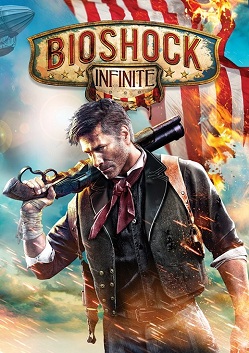
I could go on and on about how the designers set up the player's identity as and sympathy for Booker – by allowing us to see his face on multiple occasions (including a full portrait on the cover art), the desperation he shows in his death-scene flashbacks, the deep-seeded fear of water they hint at through the first part of the game – but I would have a hard time not going overboard with it. I'll just say that it's impressive to me as both a writer and a gamer. It's a compliment to the players when designers create a smart game. It shows respect of the players and of the fandom, and I appreciate it.

Welcome to Columbia, Bioshock Infinite.
This game also touts some of the best scenery in the existing trilogy, little winks to the original
Bioshock player, a complex storyline, and by far the best non-fighting companion that I've ever had. Elizabeth, who starts traveling with Booker about 20 percent (or so) of the way through the game, doesn't get injured and picks up useful items for you during battle. Go a little farther in the game, and she'll be able to bring barrels of weapons, crates of health, and mechanical fighters into the battles as well. Useful! Even better, though, is the character arc she experiences, which I will not actually touch on here. It's one of those stories that's so good, you should experience it for yourself.

Keep in mind that this is the only game of the three that does not have choice-dependent ending. Whereas Bioshock has two endings, and Bioshock 2 seems to have about four, Bioshock Infinite only has the one. That change of tactic makes me wonder if their next Bioshock game isn't completely dependent on a set up from Bioshock Infinite.

Tuesday, October 22, 2013

Telltale pisses me off again (or "Jurassic Park the Game")


Platform:  Xbox360, also available on PC, Mac, and PS3
From: Telltale Games
Downloads available: PS marketplace $19.99, Xbox Live Marketplace $19.99
Jurassic Park the Game, X-Box 360

Overall: 6/10
Good enough to hold your attention; bad enough to piss you off at the production staff.  Besides, there are super cool dinos in every episode that make playing the game worth it.

Play: 4/10
It was lazy play design that allowed me to push the buttons too late and have them count or right on time and have them not.

Plot: 6/10
Visual suspense and well-timed sensation jumps (vibration or shock noises) saved this game -- not the writing.

Characterization:  2/10
I could have been happier if they all died at the end.

Customization: 3/10
With a game that relies on timed responses, like every Telltale game out there, why is there not a calibration option?

Telltale Games has a knack for frustrating me with their "almost there" games.  Their concepts are great (who wouldn't want to meet Emmett Brown as a young adult or protect Clementine from the pain of a world filled with zombies?); but their characters are flat and unrealistic, their gameplay is regularly flawed, and their conflict is situationally driven. There are some things Telltale got right with this game:  like licensing the Jurassic Park story to begin with and keeping Nima, our sympathetic "bad guy's," motivation a secret as long as they did.   I also, personally, appreciate that they left aiming out of the equation since Telltalle notoriously leaves out Y-inversion, and I play inverted.  However, that may be all they got right.

The game begins in a well-written tutorial clip where you play an injured Nina as she runs from ... something.  She takes a dramatic spill near a cliff until she eventually falls off and in front of a Jeep.  The Jeep catches her in its headlights and slides sideways as it attempts to stop.  Nina runs to the right, blacking out the screen as she passes, and we are left to wonder whether she was hurt or not.  Those are the bits Telltale is good at: visual suspense.  Unfortunately, the story goes on.
Flat and Contrived
Flat and Contrived watch dinos before the electricity goes out. They never saw it coming, even when they were in the middle of it.

After a slight break for the opening credits, we meet our two protagonists: "Flat" and "Contrived," also known as Gerry and Jessica Harding.  They are a father-daughter duo who are separated by divorce and love dinos, but that's all the characterization they get.  Flat is a vet at the park who loves his daughter and has a tendency to — er, do nothing that sets him apart in any way from any other character ever.  Contrived is a smart, sassy every-teen who must have short-term amnesia.  Throughout the game, she's nearly eaten by dinos in every chapter, giving Flat a chance to save her.  As soon as she's safe again, Contrived will blunder herself ignorantly into another bad situation with the dinos, and the cycle continues.

The third episode is particularly badly written.  After a romp through the jungle as rescue team merc, Billy Yoder, to collect Flat, Contrived, and Mysterious (Nina), they travel to pick up Dr. Laura Sorkin.  Dr. Sorkin is a fan of dinos and protesting but not of logic.  Facepalm after facepalm ensues as Dr. Sorkin makes some of the worst decisions in the history of decision making, and everyone else just goes along with it. Pack your boxes on a helicopter instead of leaving the doomed island?  Sure! Listen to your prattle on about dino rights instead of knocking you out, dragging you onto the helicopter, and getting off the island?  Of course! Pour chemicals into the island's water supply that would allow dinos to live without InGen on the island?  Why, that sounds swell!  How could anything go wrong? Somehow, Telltale expects us to be surprised and held in suspense by these developments, and honestly, I was.  Never before have I encountered such insipid, dim-witted characters who couldn't be less interested in their own safety or survival.  There was no way I could tell what they were going to do next because it's all so contrary to normal survival instincts.

But, folks, that's as far as I'll go.  I don't want to give you too many spoilers if you plan on playing the game.  The best dinos are saved for the final plot point.

Avatar Legends: Low Budget, Great Writing


Platform:  Xbox360
From Barkers Crest Studio
Xbox Live Marketplace, 240c

Overall: 6/10
A great choice for classic gamers (think NES, SNES, Atari, Commodore 64 type gamers) who like a little snark in their throwbacks.


Play: 6/10
It is what it is, and it's nothing fancy, but it is easy to navigate for any level of gamer.  Difficulty can be changed to suit gaming experience.


Plot: 4/10
There is a typical, three-act structure hero's journey plot with multiple areas and levels to navigate through.  While the plot isn't captivating, the play on older games should keep classic gamers interested for a while.


Characterization:  7/10
We are the "hero" of the typical hero's journey, so there isn't a lot of characterization for our hero.  Many of the NPCs, however, have cool little stories that require charisma unlocks for some dialogue choices.


Customization: 5/10
In such a simple game, the only customizations are what our avatar looks like and what weapons and magic we use.  It's adequate for this kind of game.


Released on May 26, 2011, Avatar Legends has been out for a while as far as console games go, but I still found it imperative that I write some kind of review on it.  It's got the button mashing game style of old, mixed with a meta-game viewpoint writing style, and the added coolness of getting to play an RPG with your XBox360 dashboard avatar.

You start out in 'Tutorial Area' where you learn that the game is so low tech that you can't open doors and so linear that your first chest is directly in front of you. . . on the road.  After chatting with another avatar who thinks you're The One because you opened a magical chest, we step into the hero's special world as we pass out of Tutorial Area and into Hub Town.
Sure, it tickles me that they're using traditional, Joseph Campbell myth structure in their writing, but the great meta one liners put it over the top for me.  Instead of caving into this fantasy world around them, the avatars treat the world as a gamer would normally treat an RPG.

One of my favorite one liners comes from an NPC near Hub Town and completely sold me on the game the first time I played.  In this quest, your avatar has to locate a shipment of weapons for the guy at the weapons store.  He said that the shipment was supposed to be here already and he thinks that his friend got lost.  After a few snarky comments to the weapons guy, you're off on a short quest for Weapons Dealer Friend, which is actually his avatar's name.  When we find him, he's not too far outside of Hub Town.  His gear has been stolen and he needs you to fight trolls to get it back.

If you choose to whine about being sent on another quest, which I did of course, your character will say:  "Why can't things ever be easy?"

In response, Weapon Dealer Friend will say, "Because then you'd get less loot."

Understandably, my explanation probably won't elicit as many chuckles as actually playing through the game, but that interaction is a good example of the semi-meta POV you're getting here.  It runs throughout, or at least as far as I've been able to play.

Hey!  Get back here!
Battles are third person, from above and there's none of that camera staying over the shoulder stuff.  Choose your difficulty based on how well you play from that point of view.  I didn't and I was slaughtered the first time I played this.
This game has a large world.  After Hub Town, you go to another map area with three distinct sections, each with their own quests.  You have to complete at least two of those worlds in order to enter the main quest town and once you get through that town you go to another area with three distinct sections, etc.  I made it to the third world and had gotten through two of my sections before I lost my save the same week the Xbox cloud saves came out.  It was an unfortunate coincidence.

But that is beside the point.  Keep in mind that simple play plus large world makes for a lot of fetch quests that involve a lot of walking and button mashing and none of the entertaining gore that we have all become accustomed to.  If you're the type of person that takes the Bloody Mess perk in Fallout because even those head shots aren't entertaining enough for you, this is not your kind of game.

However, if you're an RPG fan, like myself, who can put up with some button mashing, you should at least try it out to experience the wonderful dialogue and see your dashboard avatar in action.  Classic gamers may appreciate this too.  It's fairly straightforward as far as quests and gameplay go and the 3rd person battle style is very similar to those old NES role playing games.

Avatar Legends is a great little geek guilty pleasure game and it totally worth the mere 240 credits needed to purchase it.  Get it on the Xbox Live Marketplace or download the trial for free!  (And then let me know so we can try out that multiplayer!)